<?xml version="1.0" encoding="utf-8"?><feed xmlns="http://www.w3.org/2005/Atom" ><generator uri="https://jekyllrb.com/" version="3.10.0">Jekyll</generator><link href="https://nikhiltrivedi.com/feed.xml" rel="self" type="application/atom+xml" /><link href="https://nikhiltrivedi.com/" rel="alternate" type="text/html" /><updated>2026-10-28T13:38:10+00:00</updated><id>https://nikhiltrivedi.com/feed.xml</id><title type="html">nikhil trivedi | Museums. Technology. Social Justice.</title><subtitle></subtitle><entry><title type="html">From Metadata to Meaning: AI and the Future of Online Collections</title><link href="https://nikhiltrivedi.com/2026/10/22/from-metadata-to-meaning-ai-and-the-future-of-online-collections.html" rel="alternate" type="text/html" title="From Metadata to Meaning: AI and the Future of Online Collections" /><published>2026-10-22T00:00:00+00:00</published><updated>2026-10-22T00:00:00+00:00</updated><id>https://nikhiltrivedi.com/2026/10/22/from-metadata-to-meaning-ai-and-the-future-of-online-collections</id><content type="html" xml:base="https://nikhiltrivedi.com/2026/10/22/from-metadata-to-meaning-ai-and-the-future-of-online-collections.html"><![CDATA[<p>At MCN 2026, I joined a panel of speakers to discuss a pivotal question: how do we thoughtfully evolve our online collection interfaces — and where do we invest first? Do we prioritize AI-powered search? AI-augmented records? Or user-facing conversational features that invite visitors to explore collections on their own terms? Each path carries different implications for trust, accuracy, and long-term sustainability. With my group of panelists we shared real-world collection redesign projects, our frameworks for evaluating AI features and functionality, and our roadmaps for future integration. We also explored what becomes possible when we think beyond institutional boundaries — sharing technical approaches, case studies, and object data across institutions.</p>

<iframe width="560" height="315" src="https://www.youtube.com/embed/dkqf2azeSKI" frameborder="0" allowfullscreen=""></iframe>

<p>Following were my remarks:</p>

<p>At the Art Institute of Chicago, we’ve had a homegrown collection management system since 1990. This has given us over 35 years to build a really rich trove of scholarly metadata in a single digital source. We describe things like classifications, materials, time periods, and styles really well.</p>

<p>But subject matter isn’t something we’ve invested as heavily in over the years.</p>

<p>Take this painting, for example. It’s a really well-known painting, both to art historians and casual enthusiasts. But few people know the name of the painting or the name of the artist. Our CMS describes this painting as realism, modernism, portrait, fashion. The one tag that gets close to describing its subject matter is “farm life.” Most people actually describe this painting as “man with pitchfork.” They’re not coming to our website looking for this painting typing in “farm life.”  They’re looking for the one with the guy with the pitchfork. And to this day, the word “pitchfork” doesn’t appear anywhere on this artwork page.</p>

<p>So we have gaps in our data. I think subject matter is probably the biggest one, and represents all sorts of opportunities that we’re looking at AI to fill.</p>

<p>But we take any decisions to adopt new technology with caution. For one, we’re a relatively small team of engineers—we’re not Netflix—building products we expect to maintain for the long term. Any new technology adds to the overall footprint of what we manage and what we need to support. This forces us to be really thoughtful about technology adoption. We won’t do AI just to do AI, there has to be a compelling reason to do so.</p>

<p>But more importantly, as an organization that’s dedicated to human-created things, we have to be careful about distributing machine-generated material. What we decide to put in front of our visitors is a reflection of who we are, and the entire apparatus of our organization. Letting a machine speak for us is not something we can approach lightly.</p>

<p>Moreover, one of our priorities as engineers is to limit building things that have an immediate integration with any third-party service, including an LLM. Models change, companies will come and go in the coming years, and we don’t want to have to scrap a feature because an integration point has disappeared. Because it does happen, and it sucks when we’re put in a bind because of it. So any approach we take with AI uses a strategy of one-time use, and saving generated content long-term so we can build off local data. As LLMs improve, we can rerun a generation process to improve our feature’s performance, but we’re not going to build something that will need one specific third-party to just always be around.</p>

<p>With all that in mind, I want to talk today about three uses of AI we have decided to take on at the Art Institute of Chicago:</p>

<ul>
  <li>Visually similar artworks</li>
  <li>Alt text for publication images</li>
  <li>Semantic search experiment</li>
</ul>

<p>First, let me give you a sense of our overall architecture. We have an API that aggregates public data from a number of different internal systems and serves it in a uniform format. This includes data on artworks, artists, exhibitions, blog articles, shop products, audio content, videos, and so much more. Our API delivers content to our website, mobile apps, in-gallery interactives, and we’ve made that same API open to the general public. Every type of content in our API also provides a search endpoint powered by Elasticsearch, which is what we’ve used to index vector embeddings that powers some of the experiments I’ll share with you today. A system like this lets us more easily scaffold new experiments with any number of technologies, AI being the latest.</p>

<p>By the end of the year, the engineering team is wrapping up implementation work to redesign the artwork pages on our website. We haven’t touched these pages since we launched the current version of our website in 2018, so this work is long overdue.</p>

<p>One particular area we’re revamping is a grid of more artworks to explore based on metadata similarity. In a region called “Most similar”, we aggregate top works that share the same style, classification, artist and time period, and show you 12 similar works based on metadata. This algorithm took a lot of tweaking to get just right, but you’ll see it still falls short. Our boy “Man with pitchfork” is tagged with “Realism” and “Oil painting,” two quite large umbrellas that leave the results feeling pretty disparate from the work you’re looking at.</p>

<p>This one suffers a similar problem, being tagged with “Impressionism” and “Oil on canvas,” two really large pools of artworks to pick from.</p>

<p>This work gets closer, but only by the luck of having a style that’s represents by a much more limited pool of works.</p>

<p>In our new artwork page design, we’re swapping this metadata-based listing with one based on AI analysis of our images. You’ll see the first one here is a parody of the same work.</p>

<p>We run a one-time script that generates vector embeddings based on the artwork image, stores those embeddings in our Elasticsearch index, and we show you the work’s nearest neighbors to present visual similarity on this page.</p>

<p>It gets us closer to what we had wanted to do with the previous functionality, and is really satisfying to see.</p>

<p>The publications department at the Art Institute of Chicago has been publishing digital scholarly catalogs about our collections and exhibitions since 2014. Originally hosted in the Drupal-based OSCI platform, we’ve since built out tools to publish new digital catalogs on our main website that include the features a reader may expect: tables of contents, paragraph numbers, citations, layered image viewers, and more. Publishing is in the middle of a multi-year migration of catalogs from our old OSCI system into our main website. So on top of their existing publication launch schedule, this means there are a LOT of images being added to our website nowadays, tens of thousands of images from publishing alone. We have an engineer-initiated process to generate alt-text for images of a specific publication and tags them so publishing staff can easily review the alt text we’re generating. Asking staff to review vs. create alt text reduces their mental load and allows us to have an adequate review process before we put machine-generated content in front of our users.</p>

<p>Finally, we’ve been working on an experiment to power the search of our collections by a vector search, with an eye towards surfacing more relevant artworks for subject-matter-based searches. So when you search “man with pitchfork,” you can more easily find the one with the guy holding a pitchfork. We feel we’ve gotten this hybrid search into a good place that serves casual enthusiasts who may be searching based on subject matter, as well as our scholarly audience who may be searching for things well documented in our metadata. But it took quite an extensive process of reviewing the search performance and iteratively tweaking our logic to get there.</p>

<p>Each time we deployed a change of the search logic to our test environment, our product manager would perform our top 100 most common searches and compare them side-by-side with what we currently have in production, and make a judgment call on whether the results Improved, were Equivalent, or Worse. He did the same thing with 150 subject matter and natural language search queries, 50 queries our curators surfaced early on when we shared a prototype with them, and the 50 most commonly searched artist names. That’s our PM doing 350 searches in test and prod side-by-side and evaluating the results for each one every time we made a change. And we did this 16 times in total with this rigor in place. We had done even more iterations before we got our stuff together. We’d discuss his findings, brainstorm the next iteration, and start over. Here’s a peak at where we’ve landed.</p>

<p>On the left is our current search experience looking solely at metadata for the search “happiness.” Lots of titles with the word “happy” in it, but not really the mood one might expect. On the right are the results of our semantic search. Objectively, these humans are happier.</p>

<p>For the search “moon,” our current search again leaves much to be desired. Our semantic search, on the other hand, is very moon-forward</p>

<p>And finally, our boy with the pitchfork. We have works by Man Ray in our collection, so the search for man with pitchfork surfaces his works early. Our semantic search, however, lots of people holding pitchforky things, and our boy’s right up there.</p>

<p>In our most recent iteration, we’ve done away with the concept of a purely hybrid search, where we try to combine metadata-based results and vector embedding-based results. We felt our metadata-only search worked REALLY WELL on scholarly searches, and our vector-based search worked really well on subject matter searches. We landed on this: before we execute a search, we run a series of checks to determine whether the search query intends to search our metadata. Depending on the outcome, we run one search or the other. So for example, if a search query contains a functional word, like “with” or “near,” or if any of the words are verbs or adverbs ending in “ing” or “ly” we’ll flag it as a vector search. In another check, we compare the search query with all our styles, artist names, and artwork names, and if the match is over a certain threshold, we’ll flag it as a metadata search. Then we’ll perform either a purely vector search, or one that looks at our metadata alone.</p>

<p>As an aggressively slow adopter of new technology, I think we’ve landed in a good place with our experiments, and look forward to building more.</p>]]></content><author><name></name></author><category term="mcn2026" /><category term="museums" /><category term="conferences" /><summary type="html"><![CDATA[At MCN 2026, I joined a panel of speakers to discuss a pivotal question: how do we thoughtfully evolve our online collection interfaces — and where do we invest first? Do we prioritize AI-powered search? AI-augmented records? Or user-facing conversational features that invite visitors to explore collections on their own terms? Each path carries different implications for trust, accuracy, and long-term sustainability. With my group of panelists we shared real-world collection redesign projects, our frameworks for evaluating AI features and functionality, and our roadmaps for future integration. We also explored what becomes possible when we think beyond institutional boundaries — sharing technical approaches, case studies, and object data across institutions.]]></summary><media:thumbnail xmlns:media="http://search.yahoo.com/mrss/" url="https://nikhiltrivedi.com/images/projects/MCN_AI_Collections.jpg" /><media:content medium="image" url="https://nikhiltrivedi.com/images/projects/MCN_AI_Collections.jpg" xmlns:media="http://search.yahoo.com/mrss/" /></entry><entry><title type="html">Digital Platforms Are Not Neutral: Actions</title><link href="https://nikhiltrivedi.com/2020/11/20/platforms-are-not-neutral.html" rel="alternate" type="text/html" title="Digital Platforms Are Not Neutral: Actions" /><published>2020-11-20T00:00:00+00:00</published><updated>2020-11-20T00:00:00+00:00</updated><id>https://nikhiltrivedi.com/2020/11/20/platforms-are-not-neutral</id><content type="html" xml:base="https://nikhiltrivedi.com/2020/11/20/platforms-are-not-neutral.html"><![CDATA[<p>At MCN 2020 I had the opportunity to present my thoughts on actions we could take to curb the exploitation of our data privacy and the impact of persuasive technology. I presented my thoughts within a framework I got from the <a href="https://www.museumaction.org">MASS Action</a> Toolkit—Awareness, Acceptance, and Action. I suggested following this framework so that any action we take is grounded in the root issues of the problems we’re addressing, with the hope that our action will be sustained long into the future.</p>

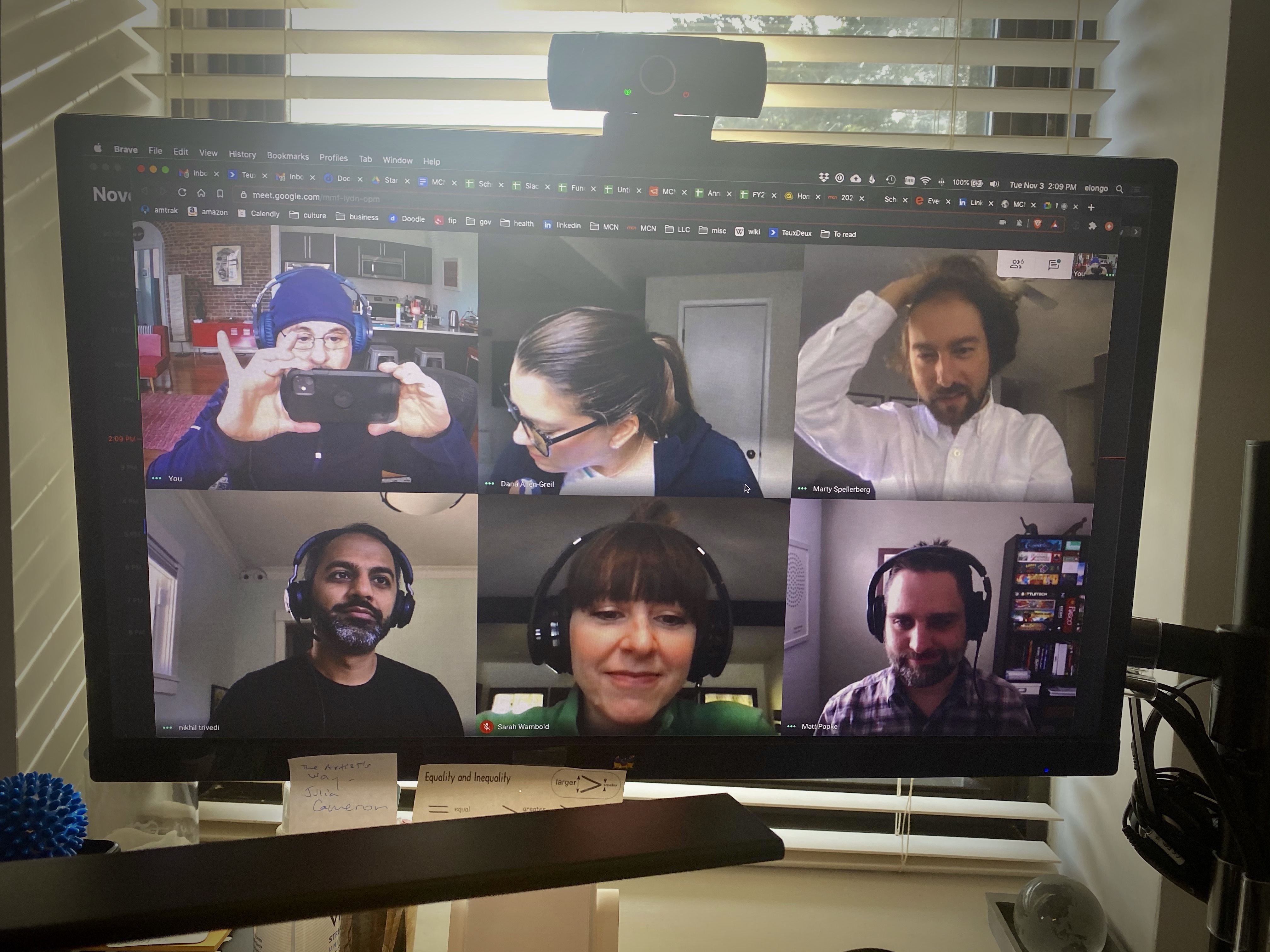
<p><img src="/images/posts/platforms-are-not-neutral-team.jpeg" alt="The six presenters of the MCN panel discussion on a Google Hangouts tiled screen during a planning call" /></p>

<h2 id="awareness">Awareness</h2>
<p>It’s important that we first and foremost understand the history of capitalism. The history of capitalism is the history of racism, classism, sexism, and all forms of systemic oppression because capitalism has always put profits over people. The exploitative patterns we’re seeing in tech are rooted in the foundations of capitalism, and can trace their roots to these same histories. For example, when we talk about surveillance we can look to the panopticon and the increasingly militarized police states many of us find ourselves living in which is can trace its roots to the survilleince of enslaved people. When we consider information being manipulated for the purpose of persuasion we can look back to treaties with Indigenous nations, an exploitative history going back hundreds of years. Captialist exploitation defines the foundations of modern society and the tech world we operate in.</p>

<p>Coming specifically to tech issues, resources for increasing our awareness include:</p>

<ul>
  <li>Electronic Frontier Foundation – eff.org</li>
  <li>Free Software Foundation – fsf.org</li>
</ul>

<p>Both orgs have been around for 30 years and have a long history of advocating for safer, more just tech. Sign up to their email lists to stay in touch with their activities. It’s also important that those of us in museum tech stay in tune with the tech world more broadly. One list I’ve found useful is <a href="techmeme.com">TechMeme</a>, a daily email that summarized headlines and responses regarding privacy and security as well as more popular news like big Apple announcements.</p>

<h2 id="acceptance">Acceptance</h2>
<p>From here it’s important that we accept a basic reality: surveillance allows platforms to sell their ability to convince us. Big tech is quite simply  a set of businesses built on their ability to convince us of things—whether it’s things to buy or people to vote for. The harvesting of things like our location data, our communications with each other, the things we like, facial recognition, their partnerships with enforcement agencies, and the eroding of net neutrality all work together to weave a thick fabric meant to maintain an oppressive status quo. As LaTanya Autry said in her session at MCN last week: Normal is broken. Normal is oppressive. Normal hurts.</p>

<p>We must acknowledge that our participation in platforms and technologies—or our non-participation—matters, however minuscule we may feel our impact might have.</p>

<p>I suggest gathering and sharing resources as much as possible. Find two people in your organization who share a similar interest, curiosity or sensibility as you, signup to the newsletters I linked above, and meet every two weeks to talk about what you’re learning. Then as you’re learning, take action together. Set yourself up so you’re not engaging in this work alone.</p>

<h2 id="action">Action</h2>
<p>Coming back to the foundations of capitalism, we must center all our action in the demand to put people over profits. Research the issues and participate in existing campaigns. EFF has an <a href="https://act.eff.org/">action center</a> where you can see all their existing campaigns. FSF currently had a <a href="https://www.fsf.org/campaigns/campaigns-summaries#surveillance">campaign on surveillance</a>.</p>

<p>Some of the campaigns ask us to contact your representatives. Do it! It’s been shown that the most effective forms of contact are to send handwritten postcards, making calls and making in-person visits (or video-conference during the pandemic). Take the two people you created a crew with and set up an in-person meeting with your reps. Much tech legislation can easily fall off of our reps’ radars as it can be hyper specific to a context they may not be familiar with. We can wear our educational-institution hats and play an important role in helping our reps understand the importance of these policies. If you’re anxious about engaging in this way due to your org being a 501(c)(3), check out this <a href="https://www.youtube.com/watch?v=2xh6ZtRk2bU">Ignite talk by Claire Blechman</a> to dispel any anxieties you might have.</p>

<p>Define your data collection and retention policies. Many of our teams may have unspoken policies, which are still policies. Take a moment to articulate them in writing. This exercise helps us to be really clear with ourselves on what our policies are, and gives us the opportunity to make sure everyone on our team is on the same page. Once you’ve written them out, review them with your team regularly to ensure you’re on the same page.</p>

<p>Then ask your vendors what their policies are. If their policies are not aligned with yours, ask them to change their policies. If you encounter resistance, talk to other customers and organize to push for change. For smaller vendors this can be effective. For larger platforms, we’ll need to rely on larger campaigns like the ones I outlined above.</p>

<p>Coming to actions that are more individual, the <a href="https://datadetoxkit.org/en/home/">Data Detox Kit</a> has a huge number of suggestions we can take. Look them over and talk to your friends and families about doing these with you. I’ve started sharing one suggestion at a time with my non-tech friends so I can serve as tech support for them if needed. Some of their suggestions include:</p>

<ul>
  <li>Turn off location services on all your apps</li>
  <li>Delete apps you don’t use every day. You can always reinstall when you need them</li>
  <li>Set duckduckgo as your default search engine on your desktop and mobile devices</li>
  <li>Do all your browsing in private or incognito windows</li>
</ul>

<p>I’m grateful for the opportunity to present on the panel discussion with some amazingly talented and smart colleagues in the museum tech field including <a href="https://swambold.com">Sarah Wambold</a>, <a href="https://danamus.es">Dana Allen-Greil</a>, <a href="https://spellerberg.org">Marty Spellerberg</a>, <a href="https://twitter.com/polackio">Matt Popke</a>, and <a href="https://www.mcn.edu">MCN</a> Execute Director Eric Longo. And thanks to the work of <a href="https://artstuffmatters.wordpress.com/">LaTanya Autry</a> and <a href="https://artmuseumteaching.com/">Mike Murawski</a> for their work on the #MuseumsAreNotNeutral campaign that inspired the name of our talk.</p>

<p>We compiled a <a href="https://docs.google.com/document/d/1RBZC9xX90QtqKzvUWQaSkZaAPV7nHmfAjNYTF0-8IQM/edit">list of additional resources</a> as well, if you’re interested in digging in and learning more about these issues.</p>]]></content><author><name></name></author><category term="mcn2020" /><category term="museums" /><category term="conferences" /><summary type="html"><![CDATA[At MCN 2020 I had the opportunity to present my thoughts on actions we could take to curb the exploitation of our data privacy and the impact of persuasive technology. I presented my thoughts within a framework I got from the MASS Action Toolkit—Awareness, Acceptance, and Action. I suggested following this framework so that any action we take is grounded in the root issues of the problems we’re addressing, with the hope that our action will be sustained long into the future.]]></summary><media:thumbnail xmlns:media="http://search.yahoo.com/mrss/" url="https://nikhiltrivedi.com/images/posts/platforms-are-not-neutral-team.jpeg" /><media:content medium="image" url="https://nikhiltrivedi.com/images/posts/platforms-are-not-neutral-team.jpeg" xmlns:media="http://search.yahoo.com/mrss/" /></entry><entry><title type="html">MCN 2017 takeaways</title><link href="https://nikhiltrivedi.com/2017/12/04/mcn-takeaways.html" rel="alternate" type="text/html" title="MCN 2017 takeaways" /><published>2017-12-04T00:00:00+00:00</published><updated>2017-12-04T00:00:00+00:00</updated><id>https://nikhiltrivedi.com/2017/12/04/mcn-takeaways</id><content type="html" xml:base="https://nikhiltrivedi.com/2017/12/04/mcn-takeaways.html"><![CDATA[<p>MCN is one of two museum technology conferences that happen annually. While there are many talks and conversations diving deep into technical topics, the conference is most known for its threads on organizational culture and social transformation. Following are some of my major takeaways.</p>

<h3 id="creating-space-slowing-down-demonstrating-our-values">Creating space, slowing down, demonstrating our values</h3>
<p>The tenor of the conference seemed to reflect the current social climate in the United States. There were lots of talks on taking care of ourselves while taking a stand on charged topics in the public discourse. Sessions included topics like <a href="https://conference.mcn.edu/2017/profile.cfm?profile_name=session&amp;master_key=51952C10-E230-0B3B-FC80-B921E0B0A824&amp;page_key=&amp;xtemplate&amp;userLGNKEY=0">self-care and slow change in a feminist framework</a> and clarifying <a href="https://www.youtube.com/watch?v=fsDSboRU1PQ">how science museums can take a public position on climate change</a>. One speaker articulated very clearly the <a href="https://www.youtube.com/watch?v=2xh6ZtRk2bU">IRS restrictions in engaging in politics</a>—endorsing a specific candidate is prohibited, but actions like engaging in political dialog and voter registration are indeed allowed.</p>

<p>The conference kicked off with a <a href="https://www.youtube.com/watch?v=pRyXH_HyPMw">keynote address</a> that was a conversation between two Black museum workers and activists, <a href="https://twitter.com/CollardStudies">Dr. Aleia Brown</a> and <a href="https://twitter.com/adriannerussell">Adrianne Russell</a>, and a Black journalist, <a href="https://twitter.com/JamilSmith">Jamil Smith</a>. Creating space for marginalized people to speak about their experiences, and privileging their voices with the opening all-conference timeslot demonstrated the core values of the conference.</p>

<p>Within an institution, <a href="https://twitter.com/_BlackMuses">Lanae Spruce</a> from the National Museum of African American History &amp; Culture talked about how their museum has a front porch, echoing common gathering spaces in Black communities. In Chicago, the steps of the MCA have been treated as a front porch in recent years. Perhaps a reflection of how they’ve created space for Black voices inside of their walls as well.</p>

<h3 id="staff-diversity">Staff diversity</h3>
<p>Many museums are continuing to think about how to diversify staff as a first step to inviting more diverse audiences. In the keynote, Dr. Aleia Brown talked about how museums “have a problem with over-credentialing for positions that don’t require it.” Jamil Smith went further to say fair pay is a concrete step we can take to diversify staff. “Any prestige brand becomes a prestige brand by good talent. You get good talent by paying for it—at all levels.”</p>

<p>A colleague echoed a suggestion I’ve heard her make in past conferences:</p>

<blockquote>
  <p>Everyone in the museum should work one frontline shift a year.</p>
</blockquote>

<h3 id="transparency">Transparency</h3>
<p>Lots of sessions talked about the need for transparency and how to get there. In making the business case for transparency, <a href="https://twitter.com/dhegley">Douglas Hegley</a> at Mia said “I can’t remember a time that me being radically transparent ruined an organization. Creating an environment that is safe and trusting is far more important that protecting any trade secrets.”</p>

<p><a href="https://twitter.com/jeffssteward">Jeff Steward</a> at the Harvard Art Museum has been aggregating different metrics across the museum to gauge the overall level of access to works in their collection, including pageviews on their website, the number of edits in their Collections Management System, movements into galleries, and check-ins to study centers, photo studios and conservation labs. He advocated for “data-informed decision” vs. “data-driven decisions.”</p>

<h3 id="honest-communication">Honest communication</h3>
<p>The tone and approach we take to communicate with our publics was a common theme, particularly among people who work in social media and publishing.</p>

<blockquote>
  <p>“Communication is an experience not just information.”</p>
</blockquote>

<p>One colleague described wanting her publications to be “like reading Teen Vogue in the dentist’s office,” referring to the magazine’s ability to take complex, multi-faceted stories and make them both skimmable and fully engaging to atypical audiences.</p>

<p>Speaking from his background in journalism, Jamil Smith suggested we use intellectual honesty as a gauge to measure diversity of voices. That it is a reflection of the safety that people of different backgrounds have to speak their ideas.</p>

<h3 id="conclusion">Conclusion</h3>
<p>Overall, MCN was a strong conference that left us with lots of thoughts, ideas and questions. It’s a conference that provides space to think deeply about critical questions, and left us with concrete tools to move our ideas forward.</p>]]></content><author><name></name></author><category term="mcn2017" /><category term="museums" /><category term="conferences" /><summary type="html"><![CDATA[MCN is one of two museum technology conferences that happen annually. While there are many talks and conversations diving deep into technical topics, the conference is most known for its threads on organizational culture and social transformation. Following are some of my major takeaways.]]></summary></entry><entry><title type="html">Mini-speech at Facilitated Conversation About Inclusion and Equity in Conservation and Preservation</title><link href="https://nikhiltrivedi.com/2017/05/29/mini-speech-at-facilitated-conversation-about-inclusion-and-equity-in-conservation-and-preservation.html" rel="alternate" type="text/html" title="Mini-speech at Facilitated Conversation About Inclusion and Equity in Conservation and Preservation" /><published>2017-05-29T00:00:00+00:00</published><updated>2017-05-29T00:00:00+00:00</updated><id>https://nikhiltrivedi.com/2017/05/29/mini-speech-at-facilitated-conversation-about-inclusion-and-equity-in-conservation-and-preservation</id><content type="html" xml:base="https://nikhiltrivedi.com/2017/05/29/mini-speech-at-facilitated-conversation-about-inclusion-and-equity-in-conservation-and-preservation.html"><![CDATA[<p>Following is a short talk that I gave at the Facilitated Conversation About Inclusion and Equity in Conservation and Preservation that took place before the American Institute for Conservation conference in May 2017. Afterwards are some details of the event.</p>

<hr />
<p>Tonight, I want us to expand our ideas of cultural institutions as places that collect and preserve the history of human ideas and human achievement. I want us to ask ourselves, if we challenge the status quo and we center our work on the people who have survived and still work to heal from these histories today, what are the possibilities? Whose lives that have been erased over time can our work uncover? What can each us do, within the scope of the work we’re already doing? Because at their core, institutions are groups of people working towards shared visions. Those people are us. We are our institutions. And we have the power to change them.</p>

<p>My mom visited my museum for the first time after almost 10 years of me working there, and after 40 years of living in my city. After looking through the South Asian sculptures, seeing Hindu murtis she hadn’t seen since she left India, one of her first questions to me was “so, how did all this stuff get here?” It didn’t take her much time to start thinking about British colonialism, becasure that history is not very old. My mom remembers colonialism. Likewise, people still remember slavery and native genocide. So while the last few years have ben pretty rough, it’s also been a rough few hundred years. Some awful and egregious things have happened to entire populations of people. We’ve been harassed, assaulted, abused, raped, trafficked and murdered en masse. And the residual effects of these traumas are still alive for many people today. Direct lines can be drawn through history to the prison industrial complex, the Dakota access pipeline, gentrification, globalized capitalism, and a number of other modern examples of these patterns playing out in our towns and cities everyday.</p>

<p>The history of human ideas and achievement is inextricably linked with some really awful, traumatic events. Our ability to travel over vast amounts of land, water and sky is entangled with histories of colonialism. Industrialization and many of the achievements in art and science that came with it couldn’t have happened if not for the forced labor of African people. The establishment and growth of our cities would not have been if not for the mass genocide of Native Americans. The word Chicago itself is rooted in indigenous languages, reminding us that we wouldn’t be here today if not for the forced removal of the people who spoke those languages, who inhabited and cared for this land for generations before the arrival of the area’s first settlers, many of whom our streets and parks are named after.</p>

<p>Cultural institutions are places that collect and preserve the history of human ideas and human achievement. What we collect and choose to preserve is limited by the histories we choose to ground our work in. Many of our institutions have benefited from the consolidation of power over time, and it limits what we see, and what we’re willing to say.</p>

<p>Over the course of the next few hours, we want to define a vision for our future, and outline what it will take to get us there. But ultimately, we want each of us in this room to recognize our own significance. To see that we have the power to transform our institutions and, indeed, change the world.</p>

<hr />

<p>For many years, activists and organizers have been calling for people to do social transformational work within their own communities. This has manifested as white people working with white people to dismantle racism, men working with men to end rape culture, and so forth. Museums have taken to this call, too, as many national museum associations have created space to talk about equity and inclusion within their segments of the museum field. As institutions whose histories are often closely tied with traumatic histories, it’s critical work to the wider vision of transforming society towards a just future that couldn’t happen anywhere else.</p>

<p>In May of 2017, 76 conservators joined this call and gathered prior to the American Institute for Conservation of Historic and Artistic Works’ Annual Meeting for a Facilitated Conversation About Inclusion and Equity in Conservation and Preservation. It was a historical convening, whose purpose was to create a sense of solidarity among colleagues to influence the power dynamics in the conservation field and to begin to develop a shared vision for pursuing a more inclusive and equitable professional practice for the future of conservation. Sanchita Balachandran, a co-organizer is the convening shares: “we wanted to imagine and create a new kind of space that is limitless in response to the kind of oppressive limiting that has been a burden of our world and its history. This act is to say we have power to change, we have power to demand and make change.” From this foundation, we hoped to give attendees an opportunity to think about how to effect change in their professional practices through both short-term and long-term actions.</p>

<p>The conversation was facilitated by nikhil trivedi, a developer at a museum in Chicago and a thought leader on oppression in the museum field, Lisa Marie Pickens, a local consultant who does strategic planning and organizational development for grassroots community organizations in Chicago, and Manju Rajendran, a national organizer who came to us by way of AORTA.</p>

<p>Attendees said they found hope in the conversation. They saw potential for greater community in the conservation field. After our four hours together, folks were overwhelmingly hungry for more time to connect and dig deeper.</p>

<p>The conversation was organized by Sanchita Balachandran, Abigail Choudhury, Lauren Fair, Heather Galloway, Morgan Eva Hayes, and Anna Serotta.</p>]]></content><author><name></name></author><category term="museums" /><category term="oppression" /><category term="equity" /><category term="facilitation" /><summary type="html"><![CDATA[Following is a short talk that I gave at the Facilitated Conversation About Inclusion and Equity in Conservation and Preservation that took place before the American Institute for Conservation conference in May 2017. Afterwards are some details of the event.]]></summary></entry><entry><title type="html">Radical road trip songs</title><link href="https://nikhiltrivedi.com/2016/07/24/radical-road-trip-songs.html" rel="alternate" type="text/html" title="Radical road trip songs" /><published>2016-07-24T00:00:00+00:00</published><updated>2016-07-24T00:00:00+00:00</updated><id>https://nikhiltrivedi.com/2016/07/24/radical-road-trip-songs</id><content type="html" xml:base="https://nikhiltrivedi.com/2016/07/24/radical-road-trip-songs.html"><![CDATA[<p>To the tune of “wheels on the bus:”</p>

<p>The people on the march say “Black lives matter!”<br />
“Black lives matter!”<br />
The people on the march say “Black lives matter!”<br />
All across the town</p>

<p>The racist-ass cops we don’t need them<br />
We don’t need them<br />
The racist-ass cops we don’t need them<br />
All across the town</p>

<p>The people blocking highways shut it down<br />
Shut it down<br />
Shut it down<br />
The people blocking highways shut it down<br />
All across the town</p>

<p>The people on the march say “Water is life!”<br />
“Water is life!”<br />
The people on the march say “Water is life!”<br />
All across the town</p>

<p>The leaders of the march say “no justice!” (No peace!)<br />
“No justice!” (No peace!)<br />
The leaders of the march say “no justice!” (No peace!)<br />
All across the town</p>

<p>The marshals on the march say “please turn here”<br />
“Please turn here”<br />
The marshals on the march say “please turn here”<br />
All across the town</p>

<p>The allies on the march they check their privilege<br />
Check their privilege<br />
The allies on the march they check their privilege<br />
All across the town</p>]]></content><author><name></name></author><category term="road trip" /><category term="kids" /><category term="social justice" /><summary type="html"><![CDATA[To the tune of “wheels on the bus:”]]></summary></entry><entry><title type="html">Text from my Ignite talk at MCN 2015</title><link href="https://nikhiltrivedi.com/2015/11/05/text-from-my-ignite-talk-at-mcn-2015.html" rel="alternate" type="text/html" title="Text from my Ignite talk at MCN 2015" /><published>2015-11-05T00:00:00+00:00</published><updated>2015-11-05T00:00:00+00:00</updated><id>https://nikhiltrivedi.com/2015/11/05/text-from-my-ignite-talk-at-mcn-2015</id><content type="html" xml:base="https://nikhiltrivedi.com/2015/11/05/text-from-my-ignite-talk-at-mcn-2015.html"><![CDATA[<p>Last night I gave an Ignite talk at MCN 2015 in Minneapolis about museums and oppression. An Ignite talk is a 5-minute presentation with 20 slides that advance automatically every 15 seconds. I fit a lot in there, so I thought it might be useful for folks at the conference to refer back to what I said. Below is a video, my slides, and the text from my talk, entitled Towards an Anti-Oppression Museum Manifesto:</p>

<iframe width="560" height="315" src="https://www.youtube.com/embed/WicEkXGqv8Q" frameborder="0" allowfullscreen=""></iframe>

<p>Check out my slides on <a href="http://www.slideshare.net/nikhiltrivedi12/towards-and-antioppression-museum-manifesto">SlideShare</a> or <a href="/IgniteMCN2015.pptx">Download the PowerPoint</a></p>

<blockquote>

  <p>Before I begin, I just want to recognize that like most things in this world, this talk wouldn’t have come together if not for the leadership and support of women and gender fluid folks. Rose, Aletheia and Porchia at Incluseum, Suse Cairns, Masum at the Smithsonian, Amita at the Skokie Public Library, Keisa Reynolds, Colleen Dilenschneider and the countless people who participated in the slides you’re about to see. So here we go!</p>

  <p><img src="/images/posts/Slide02.jpg" alt="" /></p>

  <p>I live two lives. At the Art Institute of Chicago for 10 years I’ve been surrounded by technical innovators, genius developers, smart designers, and a collection of some of the greatest documented creative achievements.</p>

  <p><img src="/images/posts/Slide03.jpg" alt="" /></p>

  <p>Outside of work, I’m surrounded by innovators of a different sort—grassroots community organizers, queer activists, radical philanthropists, prison abolitionists, rape victim advocates, healers and artists, all who look at the world through an anti-oppression lens.</p>

  <p><img src="/images/posts/Slide04.jpg" alt="" /></p>

  <p>We fight for a more just world, we work to heal our communities from historic traumatic events that are still alive for many of us today, we work to distribute power more equitably and to make our world safer for those that are the most unsafe.</p>

  <p><img src="/images/posts/Slide05.jpg" alt="" /></p>

  <p>For the future of museums, these two worlds cannot remain separate. So tonight I want to  invite you into my other life. I want to bring what I’ve learned about social justice movements to the work that we do here—producing, managing and developing technologies in museums.</p>

  <p><img src="/images/posts/Slide06.jpg" alt="" /></p>

  <p>Our spaces are alienating for many of the people I’m close to, and we’re not alone. We see museums as part of a legacy of aggression and power that our institutions have benefited from. In order for this climate to change, museums have to operate within an anti-oppression framework.</p>

  <p><img src="/images/posts/Slide07.jpg" alt="" /></p>

  <p>As a result, our institutions will change. For example, my friends and family might see themselves in our projects, collections might be presented with a critical analysis of where our objects came from and my communities might be invited to participate in mutually beneficial ways.</p>

  <p><img src="/images/posts/Slide08.jpg" alt="" /></p>

  <p>But first let’s talk about what an anti-oppression framework is. It’s a tool that came out of second-wave feminism to challenge the ways people are treated and targeted with violence based on our identities—things like race, gender, ability and so on.</p>

  <p><img src="/images/posts/Slide09.jpg" alt="" /></p>

  <p>This framework examines and addresses everything from our own assumptions to institutional policies. It believes everybody is hurt by oppression, including those in positions of privilege. And it recognizes multiple oppressions operating at the same time, all the time.</p>

  <p><img src="/images/posts/Slide10.jpg" alt="" /></p>

  <p>For instance, as a man I benefit from male supremacy, and as a person of color I’m dominated by white supremacy. And keep in mind that in this framework, no one is a bad person. The systems that perpetuate oppressions are the problem. No human is the enemy.</p>

  <p><img src="/images/posts/Slide11.jpg" alt="" /></p>

  <p>This is work that we do with love, compassion and care. So, let’s challenge ourselves this week to think about our current projects through an anti-oppression lens. How can we use what we’re already doing to create anti-oppressive spaces for our visitors?</p>

  <p><img src="/images/posts/Slide12.jpg" alt="" /></p>

  <p>There’s work like this already happening in our field. The Oakland Museum curates in cooperation with the communities they represent. They have control over program development, and the institution is conscious of their own history as tied to oppression. It’s a fundamental part of their practice.</p>

  <p><img src="/images/posts/Slide13.jpg" alt="" /></p>

  <p>For us in museum technology, it means thinking about access, but it more fundamentally requires us to interrogate the content we present. We can start by asking questions. I’ll give you a few to think about centered on history, power, and representation.</p>

  <p><img src="/images/posts/Slide14.jpg" alt="" /></p>

  <p>Whose histories do we value? How can we think about histories that have been systematically erased over time? We can examine dynamics of power to look at the perspectives we present. Whose voices are missing or have been filtered by our institutions’ motivations?</p>

  <p><img src="/images/posts/Slide15.jpg" alt="" /></p>

  <p>Finally, who gets to be represented by their own, fully empowered choice? Who doesn’t get to give permission for their legacies to be used in our work? And who decides how they’re represented?</p>

  <p><img src="/images/posts/Slide16.jpg" alt="" /></p>

  <p>As educational institutions, it’s crucial we recognize that the histories we use have been written by those who’ve held power over time. Take a moment to think about the resources that founded your collections and institutions. Are there ways they’ve has benefited from slavery, genocide, colonialism and war?</p>

  <p><img src="/images/posts/Slide17.jpg" alt="" /></p>

  <p>This is complicated work that requires time, effort and commitment. We have to be vulnerable enough to hear how we oppress others in spite of our intentions. It’s a lot to ask, so don’t do this alone. Find allies here and at your institutions.</p>

  <p><img src="/images/posts/Slide18.jpg" alt="" /></p>

  <p>I leave you with two calls to action: First, this week let’s think about how we can use our current projects to create anti-oppressive spaces for our visitors. I’m here and I’m available to support you in thinking this through, so please come find me.</p>

  <p><img src="/images/posts/Slide19.jpg" alt="" /></p>

  <p>Then, after MCN commit to a regular conversation with one other person about how your institution has benefitted from slavery, genocide, colonialism and war. And start with one question: who were the black people who have been lost in your histories?</p>

  <p><img src="/images/posts/Slide20.jpg" alt="" /></p>

  <p>That’s it, one person, one question. Can you do this? Do this for yourselves and the people you love. Do this because Black lives matter. Because Black lives have always mattered. Because trans lives matter. No more war! End all genocide! End sexual violence! Smash patriarchy!</p>

</blockquote>]]></content><author><name></name></author><category term="oppression" /><category term="museums" /><category term="mcn2015" /><category term="conferences" /><summary type="html"><![CDATA[Last night I gave an Ignite talk at MCN 2015 in Minneapolis about museums and oppression. An Ignite talk is a 5-minute presentation with 20 slides that advance automatically every 15 seconds. I fit a lot in there, so I thought it might be useful for folks at the conference to refer back to what I said. Below is a video, my slides, and the text from my talk, entitled Towards an Anti-Oppression Museum Manifesto:]]></summary></entry><entry><title type="html">Settlers of Catan replicates early U.S. treatment of indigenous and black people</title><link href="https://nikhiltrivedi.com/2015/10/12/settlers-of-catan-replicates-early-us-treatment-of-indigenous-and-black-people.html" rel="alternate" type="text/html" title="Settlers of Catan replicates early U.S. treatment of indigenous and black people" /><published>2015-10-12T00:00:00+00:00</published><updated>2015-10-12T00:00:00+00:00</updated><id>https://nikhiltrivedi.com/2015/10/12/settlers-of-catan-replicates-early-us-treatment-of-indigenous-and-black-people</id><content type="html" xml:base="https://nikhiltrivedi.com/2015/10/12/settlers-of-catan-replicates-early-us-treatment-of-indigenous-and-black-people.html"><![CDATA[<p>Thoughts on how the board game Catan replicates early U.S. treatment of indigenous and black people for Indigenous People’s Day:</p>

<ul>
  <li>Catan is described as an uninhibited island, but there’s someone already living there by the time we arrive: we’re told to call them “the robber.”</li>
  <li>The robber prevents sometimes up to three different players from collecting resources on a tile. No one person could possibly mine so much ore or harvest so much wheat that there wouldn’t be plenty for everyone to share. So perhaps the robber represents a larger community of people.</li>
  <li>When we first arrive, the robber is living in a dessert, not over-consuming any of the islands resources. As settlers, we move the robber around all over the island. Essentially, we enforce the robber to mine/harvest all the resources so no one else can have any. There are no game mechanisms to ensure they’re being paid fairly or treated well for their work.</li>
  <li>The robber is a black wooden piece.</li>
  <li>In the end, the robber doesn’t go back home to the dessert, unless the settlers decide so. The robber ends up on whatever small portion of the island we reserve them to.</li>
</ul>

<p>Some friends and I have talked about how to play Catan in a way that takes the island back from the settlers. Let’s do it! Happy Indigenous People’s Day!</p>]]></content><author><name></name></author><category term="Settlers of Catan" /><category term="colonialism" /><category term="social justice" /><summary type="html"><![CDATA[Thoughts on how the board game Catan replicates early U.S. treatment of indigenous and black people for Indigenous People’s Day:]]></summary></entry><entry><title type="html">An oppression primer for museums</title><link href="https://nikhiltrivedi.com/2015/08/10/an-oppression-primer-for-museums.html" rel="alternate" type="text/html" title="An oppression primer for museums" /><published>2015-08-10T00:00:00+00:00</published><updated>2015-08-10T00:00:00+00:00</updated><id>https://nikhiltrivedi.com/2015/08/10/an-oppression-primer-for-museums</id><content type="html" xml:base="https://nikhiltrivedi.com/2015/08/10/an-oppression-primer-for-museums.html"><![CDATA[<p>Several months ago, I wrote an article for the Incluseum blog breaking down ideas of oppression for the museum community: <a href="http://incluseum.com/2015/02/04/oppression-a-museum-primer/">Oppression: A Museum Primer</a>. Here’s an excerpt:</p>

<blockquote>

  <p>How do we shift our institutions towards a deep commitment to unravel their centuries-old patterns rooted in histories of colonialism, genocide and slavery and work to truly end oppression?</p>

  <p>It’s a big, daunting question. In a recent conversation on Twitter about how museums have responded to the movements that have gained momentum since Ferguson, it was clear to me that any meaningful response or participation must come from a place of our institutions being committed to ending the oppression that creates such awful events. So let’s talk about oppression. We’ll talk about how to recognize oppression and what we can do about it, but let’s begin by talking about what oppression is.</p>

</blockquote>

<p>Read more <a href="http://incluseum.com/2015/02/04/oppression-a-museum-primer/">here</a>.</p>]]></content><author><name></name></author><category term="museums" /><category term="oppression" /><summary type="html"><![CDATA[Several months ago, I wrote an article for the Incluseum blog breaking down ideas of oppression for the museum community: Oppression: A Museum Primer. Here’s an excerpt:]]></summary></entry><entry><title type="html">Museums and #BlackLivesMatter</title><link href="https://nikhiltrivedi.com/2014/12/12/museums-and-blacklivesmatter.html" rel="alternate" type="text/html" title="Museums and #BlackLivesMatter" /><published>2014-12-12T00:00:00+00:00</published><updated>2014-12-12T00:00:00+00:00</updated><id>https://nikhiltrivedi.com/2014/12/12/museums-and-blacklivesmatter</id><content type="html" xml:base="https://nikhiltrivedi.com/2014/12/12/museums-and-blacklivesmatter.html"><![CDATA[<p>There’ve been <a href="http://museumquestions.com/2014/12/08/should-museums-respond-to-the-grand-jury-verdicts-in-ferguson-and-new-york-city/">discussions</a> <a href="http://www.museumcommons.com/2014/12/joint-statement-museum-bloggers-colleagues-ferguson-related-events.html">among</a> <a href="https://twitter.com/search?q=%23museumsrespondtoferguson">museum professionals</a> questioning if and how our institutions should participate in the movements that have arisen from Ferguson in some way. As I’m sure many people in the conversation have been, I’ve been extremely affected by the recent decisions to not indict law enforcement in the killings of unarmed black people, and these recent injustices have occupied my mind a great deal in recent weeks. I recognize that these decisions are part of a history of the state murdering black people with impunity that goes back hundreds of years. I also recognize that this history includes the murder of and sexual violence against women and trans folks as well, whose stories are often met with silence. With this weight, I share in the great mix of emotions many of us are experiencing. And if we do talk about responding in some way, I want it to be based on reason and compassion, with an understanding of our relationships with black people and our shared histories.</p>

<p>We should ask what it would mean if institutions like ours, who have a primary interest in preserving the historic, talk about responding to the death of black people without preceding that conversation with criticism of how we engage with the living black people in the communities we serve.</p>

<p>I attended a discussion on blackness and gender violence recently hosted by <a href="http://rapevictimadvocates.org/">Rape Victim Advocates</a> and facilitated by <a href="http://wechargegenocide.org/">We Charge Genocide</a>. Part of the discussion that resonated with me was around the questions of how we express anti-blackness and what it means to say “Black lives matter.” We asked: if we don’t interact with black people in a respectful way that recognizes their full humanness everyday, do we have a right to say “Black lives matter?” If our actions don’t match our words, do they hold any meaning?</p>

<p>I think we should ask similar questions of ourselves and our museums when we wonder if we should participate in the current movements against anti-black state violence.</p>

<p>In what ways do museums express anti-blackness? Many of our large, historical institutions can link our existences closely with histories of slavery, colonialism and genocide. Black histories have systematically been erased by those who dominated the present, so in what ways do the presentations of our collections, information and our spaces erase black lives? How do we engage with the communities we reside in to mutually heal from these historical community traumas, and dismantle the ways in which they continue to operate? Museums aren’t homogenous, and each of our institutions express anti-blackness in specific ways. What meaning does saying “black lives matter” take when we simultaneously perpetuate anti-black racism?</p>

<p>Any meaningful response must come from a place of being committed to ending the oppression that has created such awful events, otherwise the response is self-serving. We must recognize that the recent killings are deeply connected with a history that includes slavery and genocide, and that many of our institutions have roots that connect with it.</p>

<p>I worry that some of the urgency we feel around responding to the recent attention on anti-black state violence comes from a fear that our institutions are not staying relevant. But I wonder, if a good number of visitors of color haven’t been to our institutions in <a href="http://www.youtube.com/watch?v=8jG1vjPM-Ks&amp;t=20m58s">over 5 years</a>, to whom are we currently relevant? Making statements in support of the current movements won’t fundamentally change the ways in which we relate to black people in our communities. I recognize that our silence is complicity, but I don’t think we have to jump further ahead than where we are. Let’s be honest with ourselves and with our communities about where we need to criticize our selves, strengthen our relationships and let’s work to build the trust that will help us grow sustaining relationships with black people in our communities. Those actions will speak louder than any of our words ever could.</p>

<p>Thanks to Keisa of We Charge Genocide for their thoughtful facilitation of the discussion I attended. Keisa asked some of the fundamental questions I bring up in this post. Also thanks to Rose from <a href="http://incluseum.com/">Incluseum</a> for helping me think through some of these ideas.</p>]]></content><author><name></name></author><category term="museums" /><category term="oppression" /><summary type="html"><![CDATA[There’ve been discussions among museum professionals questioning if and how our institutions should participate in the movements that have arisen from Ferguson in some way. As I’m sure many people in the conversation have been, I’ve been extremely affected by the recent decisions to not indict law enforcement in the killings of unarmed black people, and these recent injustices have occupied my mind a great deal in recent weeks. I recognize that these decisions are part of a history of the state murdering black people with impunity that goes back hundreds of years. I also recognize that this history includes the murder of and sexual violence against women and trans folks as well, whose stories are often met with silence. With this weight, I share in the great mix of emotions many of us are experiencing. And if we do talk about responding in some way, I want it to be based on reason and compassion, with an understanding of our relationships with black people and our shared histories.]]></summary></entry><entry><title type="html">Starting a Mens Feminist Reading Group</title><link href="https://nikhiltrivedi.com/2014/12/09/starting-a-mens-feminist-reading-group.html" rel="alternate" type="text/html" title="Starting a Mens Feminist Reading Group" /><published>2014-12-09T00:00:00+00:00</published><updated>2014-12-09T00:00:00+00:00</updated><id>https://nikhiltrivedi.com/2014/12/09/starting-a-mens-feminist-reading-group</id><content type="html" xml:base="https://nikhiltrivedi.com/2014/12/09/starting-a-mens-feminist-reading-group.html"><![CDATA[<p>Over the past year, I’ve gotten together with a group of three of my friends who are men every two months or so to read writings by feminist authors. We’ve read fiction, non-fiction, and essays by feminist writers, mostly women of color. It’s been fun for me to connect with my friends in a new way, and for all of us to grow our thinking together and be critical of ways in which we participate in sexism, male domination and rape culture. Here’s essentially what I did to get it going:</p>

<p>I posted <a href="http://thefeministwire.com/2013/06/against-patriarchy-tools-for-men-to-further-feminist-revolution/">this article</a> on Facebook and asked if any guys were interested in reading feminist literature together. In the comments of my own post, I tagged a bunch of people letting them know I was specifically thinking of them.</p>

<p>I then collected e-mail address from everyone who responded to the post in any way, whether by comment or simply liking the post. I already had emails for most of them since we already knew each other, but the others I just sent a quick Facebook message to get.</p>

<p>I then sent an e-mail to the group laying out what I envisioned: a casual reading group that gathers once every two months somewhere central to all of us, and sent out a Doodle to get a sense of what days of the week generally worked better for folks. I didn’t want to push people away for feeling like this was too formal or hardcore, I always kept it loose and very casual.</p>

<p>After a week or two, with a few casual reminders, I sent out dates for three meetings, I went ahead and picked <a href="https://www.amazon.com/Feminism-Everybody-Passionate-bell-hooks/dp/0896086283">Feminism is for Everybody</a> by bell hooks for our first book, and then started getting a sense of where people lived and worked to determine the location. We ended up reserving a room at the Harold Washington Library for our meetings (free, downtown, but can only reserve no more than two week in advance).</p>

<p>At the first meeting we did a round of introductions (name, neighborhood, gender pronoun, why we’re here), decided on group expectations, and then started talking about the book. Afterwards, we brainstormed and picked the next few books, which included fiction, non-fiction and poetry. It ended up being just four of us, and we’ve been a solid group since.</p>

<p>I think what has made the group go well is that I was sort of the glue at the beginning. We weren’t a completely random group of folks, everyone there had some sort of relationship with me, and that made it easier to build trust more quickly. It’s hard to talk about ways in which we perpetuate oppressions because we tend to feel a lot of embarrassment, shame, fear, and any number of other feelings that make it hard to be honest and vulnerable. Because we weren’t starting from scratch in our relationships, and we were a small intimate group, we ended up talking about all sorts of personal and private stuff. I don’t think that would have happened that way had it not been a group of people I was already connected to.</p>

<p>Reach out to your network and start something up! Don’t take the <em>organizing</em> of it too seriously, save that for the conversations. Be loose, fun and flexible, and people will follow!</p>]]></content><author><name></name></author><category term="feminism" /><summary type="html"><![CDATA[Over the past year, I’ve gotten together with a group of three of my friends who are men every two months or so to read writings by feminist authors. We’ve read fiction, non-fiction, and essays by feminist writers, mostly women of color. It’s been fun for me to connect with my friends in a new way, and for all of us to grow our thinking together and be critical of ways in which we participate in sexism, male domination and rape culture. Here’s essentially what I did to get it going:]]></summary></entry></feed>